
Architecture update: This article documents the March 2026 implementation. Since v0.0.5, ADR-0009 replaced the embedded Zot registry with ORAS OCI layout storage, so the satellite no longer listens on port
5050. Method 1 (network mirror to127.0.0.1:5050) and every5050check below do not work against current releases; mirroring now needs BYO registry mode. Method 2 (Direct Delivery) still works. See Delivering Images to Workloads for the current options.
Deploying Kubernetes at the edge introduces architectural challenges not seen in centralized datacenters. Edge nodes often run with intermittent, low-bandwidth, or metered connectivity. At scale, relying on a centralized registry over WAN becomes a fragile single point of failure.
Harbor Satellite mitigates this by placing a lightweight local OCI registry at each edge site, powered by Zot. It synchronizes layers from Central Harbor when connectivity is available, then serves local K3s workloads without external dependency.
1. Introduction & Challenges Addressed
Challenges & Solutions
| Edge challenge | Harbor Satellite solution |
|---|---|
| Workload failures during network partitions | Local Zot cache serves images over loopback; WAN status becomes non-blocking for runtime pulls. |
| High bandwidth costs on metered links | Layer-diff synchronization transfers only changed layers. |
| Bootstrapping restricted clusters | Direct Delivery injects images into K3s auto-import path. |
| Credential management at scale | SPIFFE/SPIRE Zero-Touch Registration (ZTR) removes static secrets from edge devices. |
| Certificate lifecycle overhead | SPIRE Workload API rotates X.509 SVIDs automatically. |
2. Reference Architecture
2.1 Network topology
- Cloud/datacenter plane: central registry, fleet management, and identity authority.
- Edge site plane: localized caching, workload runtime, and node attestation.
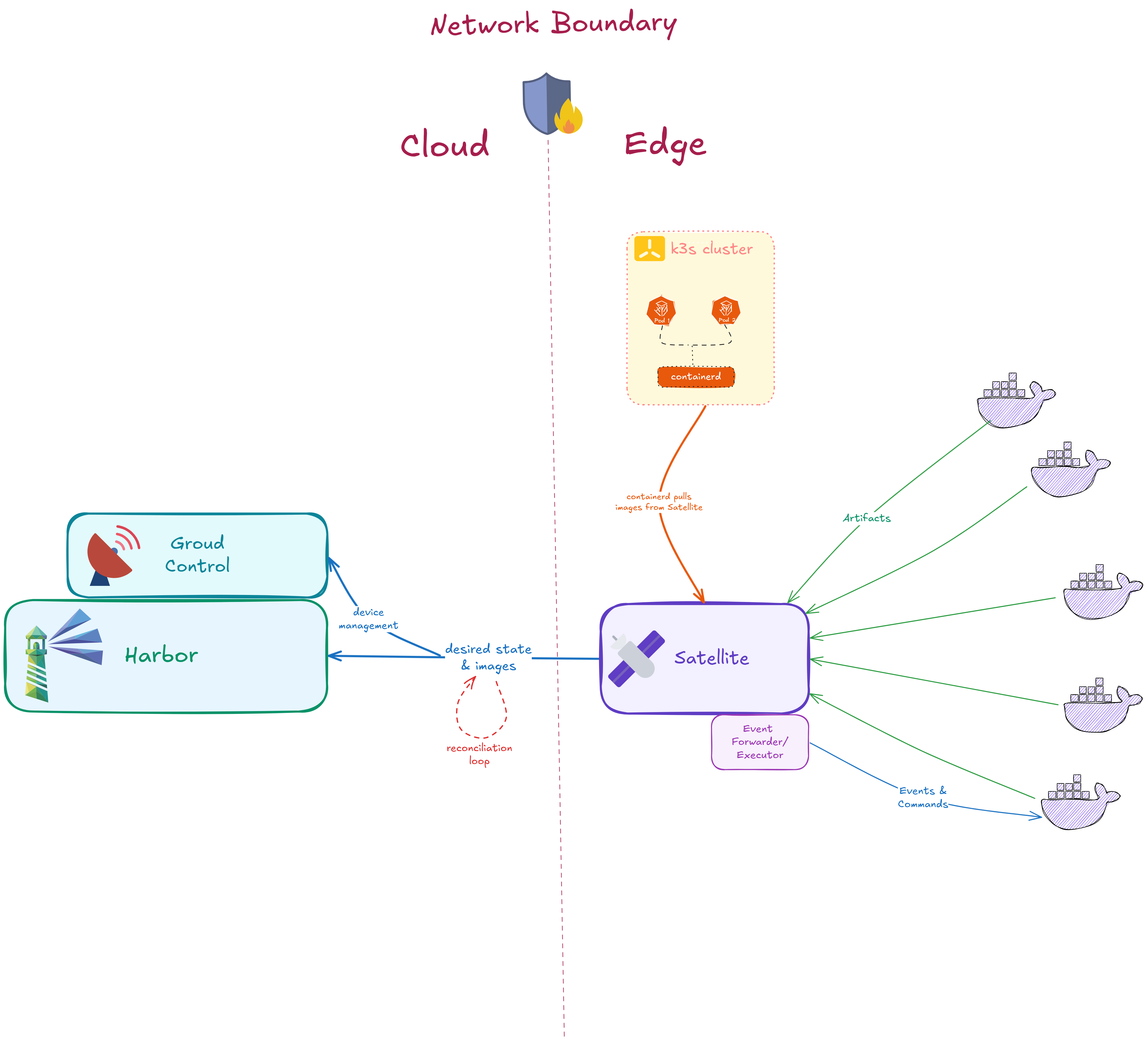
2.2 Diagram workflow
| Flow | Description |
|---|---|
| Desired state | Satellite polls Ground Control for assignments, then pulls required OCI layers from Harbor over mTLS. |
| Reconciliation loop | Satellite compares local state to cloud state, pulls new layers, and prunes stale content. |
| Containerd mirroring | K3s containerd routes pulls to 127.0.0.1:5050 for local delivery. |
| Event streaming | Event Forwarder/Executor handles telemetry and execution command exchange. |
2.3 Component placement
| Component | Deployment location | Primary role |
|---|---|---|
| Central Harbor | Cloud | Source of truth for enterprise images |
| Ground Control | Cloud | Fleet orchestration and credential brokering |
| SPIRE Server | Cloud | Root identity authority |
| SPIRE Agent (GC) | Cloud | Issues SVIDs to Ground Control |
| SPIRE Agent (Edge) | Edge node | Attests node and issues SVIDs to Satellite |
| Harbor Satellite | Edge node | Local OCI cache and replication engine |
| K3s + containerd | Edge node | Runtime configured to use the local mirror |
3. Security Model: SPIFFE/SPIRE Integration
Static registry credentials at edge scale are high risk. This architecture uses SPIFFE/SPIRE cryptographic identity with Zero-Touch Registration instead of distributing long-lived secrets.
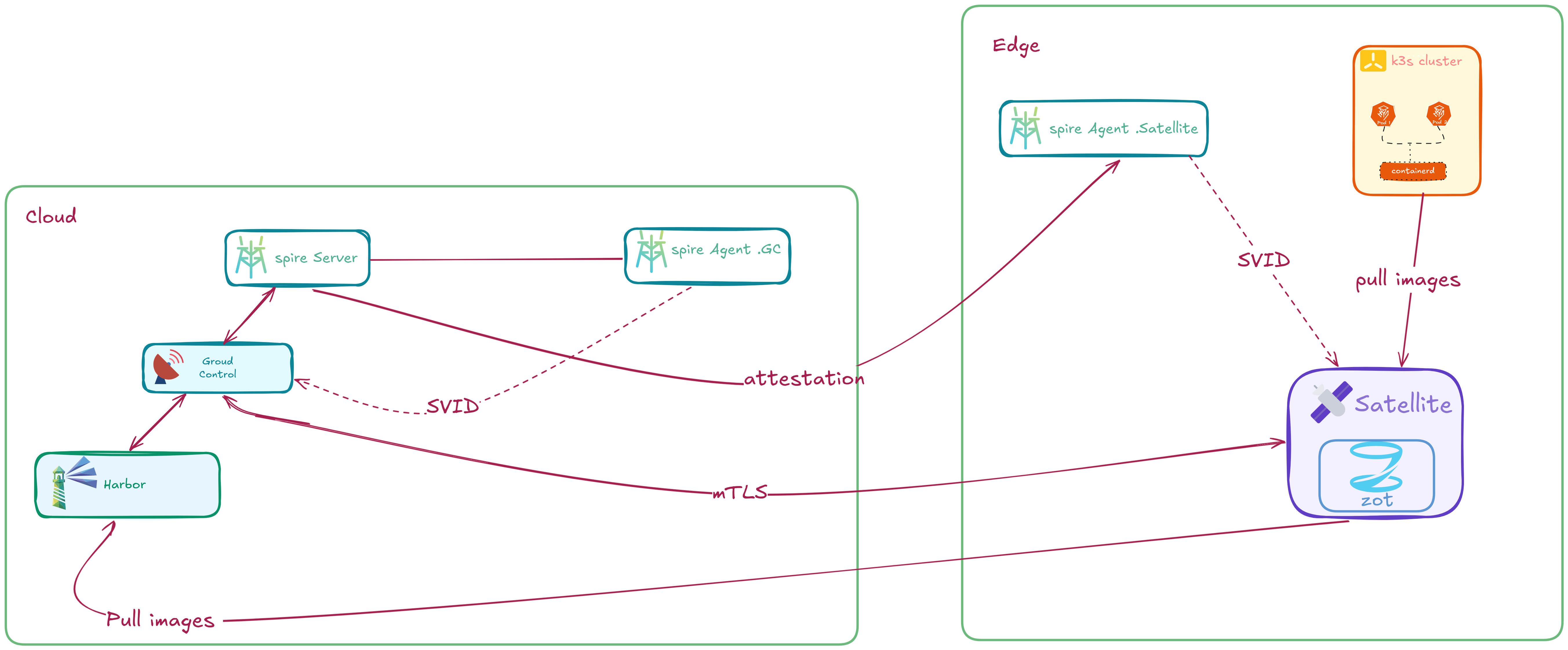
3.1 Zero-Touch Registration provisioning flow
- Token generation: Ground Control registers a new Satellite and SPIRE issues a one-time join token.
- Device attestation: Edge SPIRE Agent consumes the token and receives node identity.
- Workload identity: Harbor Satellite requests an X.509 SVID from local SPIRE Agent.
- Credential brokering: Satellite presents SVID to Ground Control over mTLS; Ground Control validates SPIFFE ID and returns scoped Harbor robot credentials.
- Steady state: Satellite encrypts credentials with device-bound fingerprint material and continues autonomous sync.
3.2 Certificate rotation and device-bound encryption
- Automated rotation: short-lived SVIDs are renewed by SPIRE before expiration.
- Hardware-change protection: credentials are encrypted with a fingerprint derived from machine-id, MAC, and disk attributes.
3.3 SPIRE attestation methods
| Method | Best fit | Notes |
|---|---|---|
join-token | Fast onboarding and test environments | One-time token, minimal prerequisites |
x509pop | PKI-centric production environments | X.509 proof-of-possession attestation |
sshpop | SSH CA-backed fleets | SSH host identity proof-of-possession |
3.4 Trust domain design
- Single trust domain: suitable when cloud and edge are managed by one platform/security team.
- Federated trust domains: suitable when regions or organizations require separate trust roots.
4. Connectivity Model
Harbor Satellite treats WAN as an optional optimization, not an operational requirement.
4.1 Background schedulers
| Scheduler | Interval | Behavior |
|---|---|---|
| State Replication | 30 seconds | Fetch desired state, pull missing layers, prune stale artifacts |
| Telemetry Heartbeat | 30 seconds | Report CPU/memory/disk and inventory status |
| Registration retry | 5 seconds | Re-authenticate and refresh credentials when required |
4.2 Bandwidth optimization with layer-diff
- Fetch lightweight image manifests from Harbor.
- Compare layer digests with local Zot cache.
- Pull only missing or changed layers.
4.3 WAN outage behavior
When WAN is unavailable, replication and heartbeat enter retry mode. Local Zot on port 5050 remains operational, and K3s continues pulling images locally without disrupting workload startup.
Method 1: Network-Based Registry Mirror
Use this when edge sites have intermittent but usable WAN.
Prerequisites
- Linux edge node with K3s
- Docker + Docker Compose
- Central Harbor reachable at
http://<CENTRAL_HARBOR_IP>:80
Step 1: Seed image in Central Harbor
# Pull the standard Nginx image
docker pull nginx:alpine

# Tag it for your Central Harbor
docker tag nginx:alpine <CENTRAL_HARBOR_IP>:80/library/nginx:alpine

# Login and push the image to Central Harbor
printf '%s\n' "<HARBOR_PASSWORD>" | docker login -u admin --password-stdin <CENTRAL_HARBOR_IP>:80
docker push <CENTRAL_HARBOR_IP>:80/library/nginx:alpine

# Remove local copies to ensure a clean test later
docker rmi nginx:alpine
docker rmi <CENTRAL_HARBOR_IP>:80/library/nginx:alpine
Step 2: Configure K3s mirror to Satellite
sudo mkdir -p /etc/rancher/k3s
sudo tee /etc/rancher/k3s/registries.yaml > /dev/null <<EOF_K3S
mirrors:
  "docker.io":
    endpoint:
      - "http://127.0.0.1:5050"
EOF_K3S
# Apply the new mirror settings
sudo systemctl restart k3s

# Force K3s to forget any previously cached images
sudo k3s crictl rmi --prune
Optional mirror wiring from Satellite runtime flags:
go run ./cmd/satellite \
  --token "<token>" \
  --ground-control-url "https://<GROUND_CONTROL_HOST>:9080" \
  --harbor-registry-url "http://<CENTRAL_HARBOR_IP>:80" \
  --mirrors=containerd:docker.io
Current releases:
--harbor-registry-urlis required, and--mirrorsis only applied together with--byo-registry --registry-url <edge-registry>. Without BYO mode the satellite logs a warning and leaves containerd untouched.
Step 3: Start Ground Control and Satellite (Zero-Touch)
cd examples/deploy/spiffe/join-token/external/gc
HARBOR_URL=http://<CENTRAL_HARBOR_IP>:80 ./setup.sh
cd ../sat
HARBOR_REGISTRY_URL=http://<CENTRAL_HARBOR_IP>:80 ./setup.sh
Verify SPIFFE onboarding and robot account provisioning:
docker logs ground-control | grep "SPIFFE ZTR"
Step 4: Assign image sync policy to the edge
# Get Ground Control Bearer Token
TOKEN=$(curl -sk -X POST "https://localhost:9080/login" -d '{"username":"admin","password":"<ADMIN_PASSWORD>"}' | grep -o '"token":"[^"]*"' | cut -d'"' -f4)

# Get the SHA256 Digest from Central Harbor
DIGEST=$(curl -sk -u "admin:<HARBOR_PASSWORD>" "http://<CENTRAL_HARBOR_IP>/api/v2.0/projects/library/repositories/nginx/artifacts?q=tags%3Dalpine&page_size=1" | grep -m1 '"digest":' | cut -d'"' -f4)
# Create the Edge Group
curl -sk -X POST "https://localhost:9080/api/groups/sync" \
  -H "Content-Type: application/json" \
  -H "Authorization: Bearer ${TOKEN}" \
  -d "{\"group\": \"edge-group\", \"registry\": \"http://<CENTRAL_HARBOR_IP>:80\", \"artifacts\": [{\"repository\": \"library/nginx\", \"tag\": [\"alpine\"], \"type\": \"image\", \"digest\": \"${DIGEST}\"}]}"

# Link the Satellite to the Group
curl -sk -X POST "https://localhost:9080/api/groups/satellite" \
  -H "Content-Type: application/json" \
  -H "Authorization: Bearer ${TOKEN}" \
  -d '{"satellite": "edge-01", "group": "edge-group"}'
Verify artifact replication to local Satellite:
curl -s http://127.0.0.1:5050/v2/_catalog
# Expected: {"repositories":["library/nginx"]}
Current releases: there is no registry on
5050. Check the OCI layout instead:docker exec satellite cat /data/oci/index.json
Step 5: Air-gap behavior test
# Simulate outage of central components
docker stop harbor-core ground-control harbor-db redis registry registryctl harbor-portal harbor-log harbor-jobservice nginx
# Deploy workload using standard image name
kubectl run true-airgap-test --image=nginx:alpine
Current releases: this test relies on the
127.0.0.1:5050mirror and fails without a BYO registry at that address. Use Method 2 for offline pulls.
Validation checks:
kubectl describe pod true-airgap-test | grep -A 5 "Events:"
docker logs satellite | grep "nginx/blobs"
Method 2: Automated Air-Gap via Direct Delivery
Use this when sites must run with no live registry path.
Method 2 Prerequisites
- Method 1 completed through sync assignment
- Root access on K3s node
- Edit access to
examples/deploy/spiffe/join-token/external/sat/docker-compose.yml
Step 1: Enable Direct Delivery in Satellite
# examples/deploy/spiffe/join-token/external/sat/docker-compose.yml
services:
  satellite:
    user: "0:0" # the image runs as a non-root user; writing to the k3s images directory needs root
    environment:
      - DIRECT_DELIVERY=true
      - IMAGE_DIR=/var/lib/rancher/k3s/agent/images
    volumes:
      - /var/lib/rancher/k3s/agent/images:/var/lib/rancher/k3s/agent/images
Restart Satellite:
cd examples/deploy/spiffe/join-token/external/sat
docker compose up -d satellite --build

# Optional: confirm Direct Delivery is active
docker logs satellite | grep -E "direct delivery enabled|Direct delivery: tarball written"
If using RKE2, set IMAGE_DIR=/var/lib/rancher/rke2/agent/images.
Step 2: Trigger sync and verify auto-import
# Get Ground Control Bearer Token
TOKEN=$(curl -sk -X POST "https://localhost:9080/login" -d '{"username":"admin","password":"<ADMIN_PASSWORD>"}' | grep -o '"token":"[^"]*"' | cut -d'"' -f4)

# Get image digest from Harbor
DIGEST=$(curl -sk -u "admin:<HARBOR_PASSWORD>" "http://<CENTRAL_HARBOR_IP>/api/v2.0/projects/library/repositories/nginx/artifacts?q=tags%3Dalpine&page_size=1" | grep -m1 '"digest":' | cut -d'"' -f4)

# Create sync group
curl -sk -X POST "https://localhost:9080/api/groups/sync" \
  -H "Content-Type: application/json" \
  -H "Authorization: Bearer ${TOKEN}" \
  -d "{\"group\": \"edge-group\", \"registry\": \"http://<CENTRAL_HARBOR_IP>:80\", \"artifacts\": [{\"repository\": \"library/nginx\", \"tag\": [\"alpine\"], \"type\": \"image\", \"digest\": \"${DIGEST}\"}]}"

# Assign satellite to group
curl -sk -X POST "https://localhost:9080/api/groups/satellite" \
  -H "Content-Type: application/json" \
  -H "Authorization: Bearer ${TOKEN}" \
  -d '{"satellite": "edge-01", "group": "edge-group"}'

# Confirm Satellite delivered the artifact
docker logs satellite | grep "Direct delivery: tarball written"
Then verify image appears in K3s runtime:
sudo k3s crictl rmi --prune
sudo k3s crictl images | grep "<CENTRAL_HARBOR_IP>:80/library/nginx"
Step 3: Offline validation
# Simulate outage
docker stop satellite spire-agent-satellite ground-control harbor-core harbor-db harbor-jobservice harbor-portal harbor-satellite-postgres harbor-log

# Deploy with upstream Harbor URL
sudo kubectl run test --image=<CENTRAL_HARBOR_IP>:80/library/nginx:alpine
sudo kubectl get pod test
Verify cached image hit:
sudo kubectl describe pod test | grep "Container image"
Expected signal: image is already present on machine.
Choosing between methods
| Need | Recommended method |
|---|---|
| Simple operations and periodic connectivity | Method 1 (Network Mirror) |
| Maximum offline assurance | Method 2 (Direct Delivery) |
Enterprise use cases
Retail / POS
- Challenge: WAN outage at a branch blocks image pulls and POS restarts.
- Solution: Satellite keeps POS images local, so K3s workloads continue from
127.0.0.1:5050.
Industrial IoT (SUSE + Bosch model)
- Challenge: Factory edge sites operate on restricted networks and cannot tolerate restart failures.
- Solution: Ground Control pre-stages required artifacts to Satellite; K3s continues local pulls during WAN interruptions.
Final note
Both methods follow the same architecture: centralized policy, edge-local artifacts, and identity-based trust. Start with Method 1 for faster rollout, then move critical sites to Method 2 when strict offline guarantees are required.